1 threaded_irq引入
工作队列用起来挺简单,但是它有一个缺点:工作队列中有多个 work,前一个 work 没处理完会影响后面的 work执行,导致后面的work没法快速响应。那么可以再内核自己创建一个线程来单独处理,不跟别的 work 凑在一块了。比如在 Linux 系统中,对于存储设备比如 SD/TF 卡,它的驱动程序就是这样做的,它有自己的内核线程。用kthread_creat创建内核线程。
对于中断处理,还有另一种方法:threaded irq,线程化的中断处理。中断的处理仍然可以认为分为上半部、下半部。上半部用来处理紧急的事情,下半部用一个内核线程来处理,这个内核线程专用于这个中断。
2 threaded_irq使用
前面的文章已经提到了threaded_irq。
- 可以只提供
thread_fn,内核会提供默认的上半部处理函数irq_default_primary_handler,该函数只是返回一个IRQ_WAKE_THREAD。发生中断时,系统会立刻调用 handler 函数,然后唤醒某个内核线程,内核线程再来执行thread_fn函数。 - 也可以既提供
handler函数,也提供thread_fn函数。等硬件中断到来,先执行handler函数,handler函数中返回IRQ_WAKE_THREAD去唤醒中断线程函数thread_fn。

extern int __must_check
devm_request_threaded_irq(struct device *dev, unsigned int irq,
			  irq_handler_t handler, irq_handler_t thread_fn,
			  unsigned long irqflags, const char *devname,
			  void *dev_id);
//include\linux\interrupt.h
static inline int __must_check
devm_request_irq(struct device *dev, unsigned int irq, irq_handler_t handler,
		 unsigned long irqflags, const char *devname, void *dev_id)
{
	return devm_request_threaded_irq(dev, irq, handler, NULL, irqflags,
					 devname, dev_id);
}
extern int __must_check
request_threaded_irq(unsigned int irq, irq_handler_t handler,
		     irq_handler_t thread_fn,
		     unsigned long flags, const char *name, void *dev);

static inline int __must_check
request_irq(unsigned int irq, irq_handler_t handler, unsigned long flags,
	    const char *name, void *dev)
{
	return request_threaded_irq(irq, handler, NULL, flags, name, dev);
}
extern void free_irq(unsigned int, void *);
3 threaded_irq实例
3.1 驱动源码编写
驱动代码
#include <linux/module.h>
#include <linux/poll.h>
#include <linux/fs.h>
#include <linux/errno.h>
#include <linux/miscdevice.h>
#include <linux/kernel.h>
#include <linux/major.h>
#include <linux/mutex.h>
#include <linux/proc_fs.h>
#include <linux/seq_file.h>
#include <linux/stat.h>
#include <linux/init.h>
#include <linux/device.h>
#include <linux/tty.h>
#include <linux/kmod.h>
#include <linux/gfp.h>
#include <linux/gpio/consumer.h>
#include <linux/platform_device.h>
#include <linux/of_gpio.h>
#include <linux/of_irq.h>
#include <linux/interrupt.h>
#include <linux/irq.h>
#include <linux/slab.h>
#include <linux/fcntl.h>
#include <linux/timer.h>
#include <linux/workqueue.h>
#include <asm/current.h>

struct gpio_key{
	int gpio;
	struct gpio_desc *gpiod;
	int flag;
	int irq;
	struct timer_list key_timer;
	struct tasklet_struct tasklet;
	struct work_struct work;
} ;
static struct gpio_key *gpio_keys_100ask;
static int major = 0;
static struct class *gpio_key_class;

#define BUF_LEN 128
static int g_keys[BUF_LEN];
static int r, w;

struct fasync_struct *button_fasync;
#define NEXT_POS(x) ((x+1) % BUF_LEN)
static int is_key_buf_empty(void){
	return (r == w);
}

static int is_key_buf_full(void){
	return (r == NEXT_POS(w));
}
static void put_key(int key){
	if (!is_key_buf_full()){
		g_keys[w] = key;
		w = NEXT_POS(w);
	}
}
static int get_key(void){
	int key = 0;
	if (!is_key_buf_empty()){
		key = g_keys[r];
		r = NEXT_POS(r);
	}
	return key;
}

static DECLARE_WAIT_QUEUE_HEAD(gpio_key_wait);
static void key_timer_expire(unsigned long data){
	struct gpio_key *gpio_key = data;
	int val;
	int key;
	val = gpiod_get_value(gpio_key->gpiod);

	printk("key_timer_expire key %d %d\n", gpio_key->gpio, val);
	key = (gpio_key->gpio << 8) | val;
	put_key(key);
	wake_up_interruptible(&gpio_key_wait);
	kill_fasync(&button_fasync, SIGIO, POLL_IN);
}

static void key_tasklet_func(unsigned long data){
	struct gpio_key *gpio_key = data;
	int val;
	int key;

	val = gpiod_get_value(gpio_key->gpiod);
	printk("key_tasklet_func key %d %d\n", gpio_key->gpio, val);
}
static void key_work_func(struct work_struct *work){
	struct gpio_key *gpio_key = container_of(work, struct gpio_key, work);
	int val;

	val = gpiod_get_value(gpio_key->gpiod);
	printk("key_work_func: the process is %s pid %d\n",current->comm, current->pid);
	printk("key_work_func key %d %d\n", gpio_key->gpio, val);
}
static ssize_t gpio_key_drv_read (struct file *file, char __user *buf, size_t size, loff_t *offset){
	int err;
	int key;
	if (is_key_buf_empty() && (file->f_flags & O_NONBLOCK))
		return -EAGAIN;
	wait_event_interruptible(gpio_key_wait, !is_key_buf_empty());
	key = get_key();
	err = copy_to_user(buf, &key, 4);
	return 4;
}
static unsigned int gpio_key_drv_poll(struct file *fp, poll_table * wait){
	poll_wait(fp, &gpio_key_wait, wait);
	return is_key_buf_empty() ? 0 : POLLIN | POLLRDNORM;
}

static int gpio_key_drv_fasync(int fd, struct file *file, int on){
	if (fasync_helper(fd, file, on, &button_fasync) >= 0)
		return 0;
	else
		return -EIO;
}
static struct file_operations gpio_key_drv = {
	.owner	 = THIS_MODULE,
	.read    = gpio_key_drv_read,
	.poll    = gpio_key_drv_poll,
	.fasync  = gpio_key_drv_fasync,
};
static irqreturn_t gpio_key_isr(int irq, void *dev_id){
	struct gpio_key *gpio_key = dev_id;
	//printk("gpio_key_isr key %d irq happened\n", gpio_key->gpio);
	tasklet_schedule(&gpio_key->tasklet);
	mod_timer(&gpio_key->key_timer, jiffies + HZ/50);
	schedule_work(&gpio_key->work);
	return IRQ_WAKE_THREAD;
}

static irqreturn_t gpio_key_thread_func(int irq, void *data){
	struct gpio_key *gpio_key = data;
	int val;

	val = gpiod_get_value(gpio_key->gpiod);
	printk("gpio_key_thread_func: the process is %s pid %d\n",current->comm, current->pid);
	printk("gpio_key_thread_func key %d %d\n", gpio_key->gpio, val);
	return IRQ_HANDLED;
}

static int gpio_key_probe(struct platform_device *pdev){
	int err;
	struct device_node *node = pdev->dev.of_node;
	int count;
	int i;
	enum of_gpio_flags flag;

	count = of_gpio_count(node);
	if (!count){
		printk("%s %s line %d, there isn't any gpio available\n",
               __FILE__, __FUNCTION__, __LINE__);
		return -1;
	}

	gpio_keys_100ask = kzalloc(sizeof(struct gpio_key) * count, GFP_KERNEL);
	for (i = 0; i < count; i++){
		gpio_keys_100ask[i].gpio = of_get_gpio_flags(node, i, &flag);
		if (gpio_keys_100ask[i].gpio < 0){
			printk("%s %s line %d, of_get_gpio_flags fail\n",
                   __FILE__, __FUNCTION__, __LINE__);
			return -1;
		}
		gpio_keys_100ask[i].gpiod = gpio_to_desc(gpio_keys_100ask[i].gpio);
		gpio_keys_100ask[i].flag = flag & OF_GPIO_ACTIVE_LOW;
		gpio_keys_100ask[i].irq  = gpio_to_irq(gpio_keys_100ask[i].gpio);
		setup_timer(&gpio_keys_100ask[i].key_timer, key_timer_expire, &gpio_keys_100ask[i]);
		gpio_keys_100ask[i].key_timer.expires = ~0;
		add_timer(&gpio_keys_100ask[i].key_timer);
		tasklet_init(&gpio_keys_100ask[i].tasklet, key_tasklet_func, &gpio_keys_100ask[i]);
		INIT_WORK(&gpio_keys_100ask[i].work, key_work_func);
	}

	for (i = 0; i < count; i++){
		//err = request_irq(gpio_keys_100ask[i].irq, gpio_key_isr
        //, IRQF_TRIGGER_RISING | IRQF_TRIGGER_FALLING
        //, "100ask_gpio_key", &gpio_keys_100ask[i]);
		err = request_threaded_irq(gpio_keys_100ask[i].irq, gpio_key_isr
        						   , gpio_key_thread_func,
                                   IRQF_TRIGGER_RISING | IRQF_TRIGGER_FALLING
                                   , "100ask_gpio_key", &gpio_keys_100ask[i]);
	}

	major = register_chrdev(0, "100ask_gpio_key", &gpio_key_drv);
	gpio_key_class = class_create(THIS_MODULE, "100ask_gpio_key_class");
	if (IS_ERR(gpio_key_class)) {
		printk("%s %s line %d\n", __FILE__, __FUNCTION__, __LINE__);
		unregister_chrdev(major, "100ask_gpio_key");
		return PTR_ERR(gpio_key_class);
	}
	device_create(gpio_key_class, NULL, MKDEV(major, 0), NULL, "100ask_gpio_key");
    return 0;
}

static int gpio_key_remove(struct platform_device *pdev){
	struct device_node *node = pdev->dev.of_node;
	int count;
	int i;
	device_destroy(gpio_key_class, MKDEV(major, 0));
	class_destroy(gpio_key_class);
	unregister_chrdev(major, "100ask_gpio_key");
	count = of_gpio_count(node);
	for (i = 0; i < count; i++){
		free_irq(gpio_keys_100ask[i].irq, &gpio_keys_100ask[i]);
		del_timer(&gpio_keys_100ask[i].key_timer);
		tasklet_kill(&gpio_keys_100ask[i].tasklet);
	}
	kfree(gpio_keys_100ask);
    return 0;
}
static const struct of_device_id ask100_keys[] = {
    { .compatible = "100ask,gpio_key" },
    { },
};
static struct platform_driver gpio_keys_driver = {
    .probe      = gpio_key_probe,
    .remove     = gpio_key_remove,
    .driver     = {
        .name   = "100ask_gpio_key",
        .of_match_table = ask100_keys,
    },
};
static int __init gpio_key_init(void){
    int err;
    err = platform_driver_register(&gpio_keys_driver);
	return err;
}

static void __exit gpio_key_exit(void){
    platform_driver_unregister(&gpio_keys_driver);
}
module_init(gpio_key_init);
module_exit(gpio_key_exit);
MODULE_LICENSE("GPL");
3.2 app代码编写
app代码
#include <sys/types.h>
#include <sys/stat.h>
#include <fcntl.h>
#include <unistd.h>
#include <stdio.h>
#include <string.h>
#include <poll.h>
#include <signal.h>
static int fd;

/*
 * ./button_test /dev/100ask_button0
 *
 */
int main(int argc, char **argv){
	int val;
	struct pollfd fds[1];
	int timeout_ms = 5000;
	int ret;
	int	flags;
	int i;
	if (argc != 2) {
		printf("Usage: %s <dev>\n", argv[0]);
		return -1;
	}
	fd = open(argv[1], O_RDWR | O_NONBLOCK);
	if (fd == -1){
		printf("can not open file %s\n", argv[1]);
		return -1;
	}
	for (i = 0; i < 10; i++) {
		if (read(fd, &val, 4) == 4)
			printf("get button: 0x%x\n", val);
		else
			printf("get button: -1\n");
	}
	flags = fcntl(fd, F_GETFL);
	fcntl(fd, F_SETFL, flags & ~O_NONBLOCK);
	while (1){
		if (read(fd, &val, 4) == 4)
			printf("get button: 0x%x\n", val);
		else
			printf("while get button: -1\n");
	}
	close(fd);
	return 0;
}
3.3 驱动代码解析
 为每个按键注册中断服务
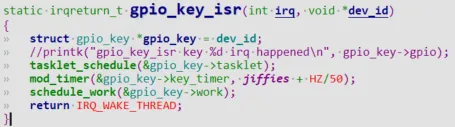 硬件中断上半部irq中做完重要事情如:清中断,然后返回IRQ_WAKE_THREAD
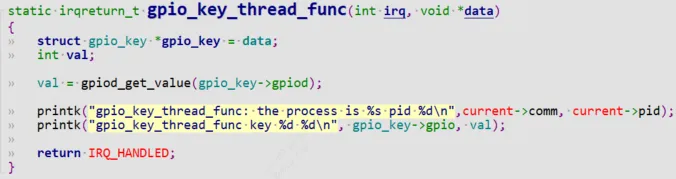 返回后,内核线程开始调度
gpio_key_thread_func,中断线程化的处理函数gpio_key_thread_func做完后返回IRQ_HANDLED;
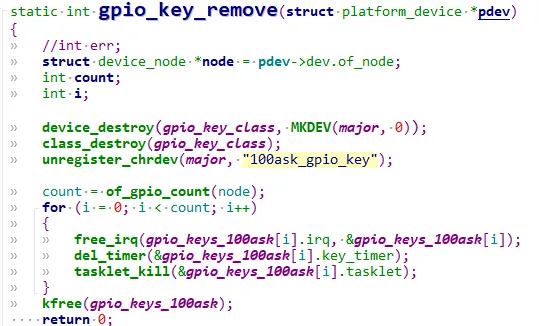 最后卸载驱动时取消irq注册.
4 threaded_irq内核机制
struct irq_desc结构: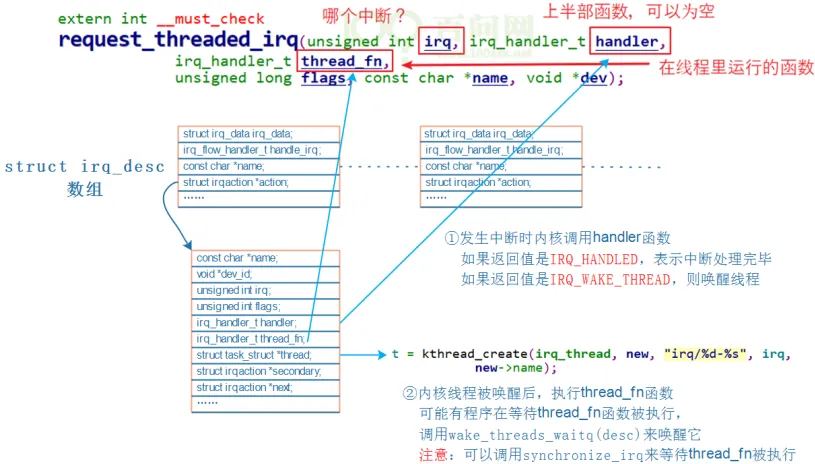
1. 当发生中断时,handler函数被调用,如果返回IRQ_HANDLED,表示中断处理完毕,如果返回IRQ_WAKE_THREAD表示要唤醒thread_fn.
2. 内核线程唤醒后,执行thread_fn
4.1 request_threaded_irq过程
int request_threaded_irq(unsigned int irq, irq_handler_t handler,
			 irq_handler_t thread_fn, unsigned long irqflags,
			 const char *devname, void *dev_id){
	struct irqaction *action;
	struct irq_desc *desc;
	int retval;
	if (irq == IRQ_NOTCONNECTED)
		return -ENOTCONN;
	if (((irqflags & IRQF_SHARED) && !dev_id) |
	    (!(irqflags & IRQF_SHARED) && (irqflags & IRQF_COND_SUSPEND)) |
	    ((irqflags & IRQF_NO_SUSPEND) && (irqflags & IRQF_COND_SUSPEND)))
		return -EINVAL;

	desc = irq_to_desc(irq);  //1
	if (!desc)
		return -EINVAL;

	if (!irq_settings_can_request(desc) |
	    WARN_ON(irq_settings_is_per_cpu_devid(desc)))
		return -EINVAL;

	if (!handler) {
		if (!thread_fn)
			return -EINVAL;
		handler = irq_default_primary_handler;
	}

	action = kzalloc(sizeof(struct irqaction), GFP_KERNEL);
	if (!action)
		return -ENOMEM;

	action->handler = handler;   //2
	action->thread_fn = thread_fn;
	action->flags = irqflags;
	action->name = devname;
	action->dev_id = dev_id;

	retval = irq_chip_pm_get(&desc->irq_data);
	if (retval < 0) {
		kfree(action);
		return retval;
	}

	chip_bus_lock(desc);
	retval = __setup_irq(irq, desc, action); //3
	chip_bus_sync_unlock(desc);

	if (retval) {
		irq_chip_pm_put(&desc->irq_data);
		kfree(action->secondary);
		kfree(action);
	}

#ifdef CONFIG_DEBUG_SHIRQ_FIXME
	if (!retval && (irqflags & IRQF_SHARED)) {
		/*
		 * It's a shared IRQ -- the driver ought to be prepared for it
		 * to happen immediately, so let's make sure....
		 * We disable the irq to make sure that a 'real' IRQ doesn't
		 * run in parallel with our fake.
		 */
		unsigned long flags;

		disable_irq(irq);
		local_irq_save(flags);
		handler(irq, dev_id);
		local_irq_restore(flags);
		enable_irq(irq);
	}
#endif
	return retval;
}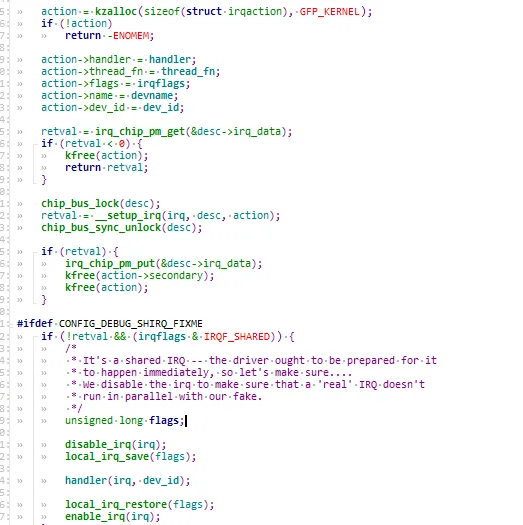
首先根据
irq num获取到struct irq_desc信息。然后分配、设置一个
irqaction结构体。设置中断相关参数然后进入
__setup_irq,__setup_irq函数核心代码如下:
4.1.1 __setup_irq
4.1.1.1 setup_irq_thread
if (new->thread_fn && !nested) {
	ret = setup_irq_thread(new, irq, false);
//setup_irq_thread函数核心代码如下:
if (!secondary) {
	t = kthread_create(irq_thread, new, "irq/%d-%s", irq,
	 new->name);
} else {
	t = kthread_create(irq_thread, new, "irq/%d-s-%s", irq,
	 new->name);
	param.sched_priority -= 1;
}
new->thread = t;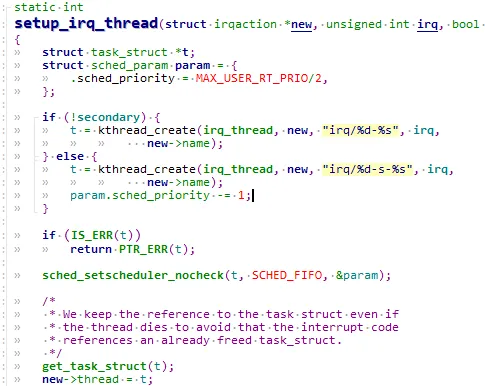
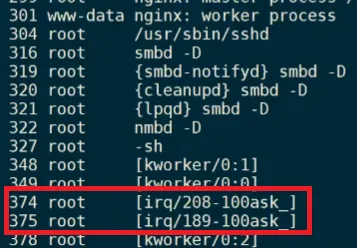 ①可以看到创建了
irq_thread这个内核线程。线程名字为“irq/pid-中断名字”。
kthread_create()只是创建一个内核线程,但并没有启动,需要调用wake_up_process()来启动线程,所以内核又帮我们定义了一个宏kthread_run来帮我们搞定. 来看kthread相关API:
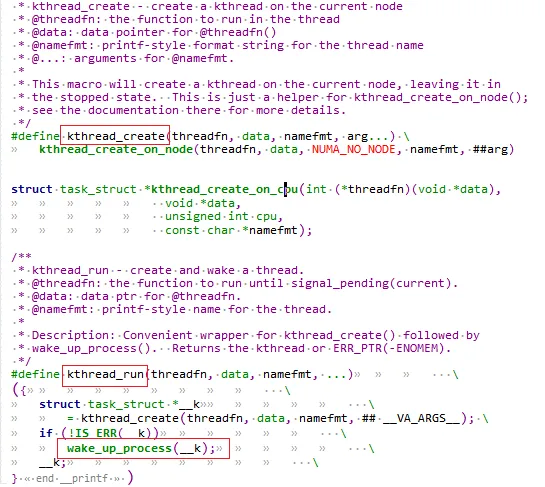
#define kthread_create(threadfn, data, namefmt, arg...) \
	kthread_create_on_node(threadfn, data, NUMA_NO_NODE, namefmt, ##arg)
struct task_struct *kthread_create_on_cpu(int (*threadfn)(void *data),
					  void *data,
					  unsigned int cpu,
					  const char *namefmt);
/**
 * kthread_run - create and wake a thread.
 * @threadfn: the function to run until signal_pending(current).
 * @data: data ptr for @threadfn.
 * @namefmt: printf-style name for the thread.
 *
 * Description: Convenient wrapper for kthread_create() followed by
 * wake_up_process().  Returns the kthread or ERR_PTR(-ENOMEM).
 */
#define kthread_run(threadfn, data, namefmt, ...)			   \
({									   \
	struct task_struct *__k						   \
		= kthread_create(threadfn, data, namefmt, ## __VA_ARGS__); \
	if (!IS_ERR(__k))						   \
		wake_up_process(__k);					   \
	__k;								   \
})
int kthread_stop(struct task_struct *k);②然后将创建内核线程返回的task_strcut给到irqaction.(new->trhead = t;这句)
我们知道irqaction就包含了thread_fn和handler。
4.2 中断后处理thread_fn是怎么被执行的
4.2.1 上半部硬件中断的调用过程
当中断产生时,用gdb看看gic驱动框架调用关系:
Breakpoint 1, gpio_keys_gpio_isr (irq=200, dev_id=0x863e6930) at drivers/input/keybo
ard/gpio_keys.c:393
393 {
(gdb) bt
#0 gpio_keys_gpio_isr (irq=200, dev_id=0x863e6930) at drivers/input/keyboard/gpio_k
eys.c:393
#1 0x80270528 in __handle_irq_event_percpu (desc=0x8616e300, flags=0x86517edc) at ke
rnel/irq/handle.c:145
#2 0x802705cc in handle_irq_event_percpu (desc=0x8616e300) at kernel/irq/handle.c:18
5
#3 0x80270640 in handle_irq_event (desc=0x8616e300) at kernel/irq/handle.c:202
#4 0x802738e8 in handle_level_irq (desc=0x8616e300) at kernel/irq/chip.c:518
#5 0x8026f7f8 in generic_handle_irq_desc (desc=<optimized out>) at ./include/linux/i
rqdesc.h:150
#6 generic_handle_irq (irq=<optimized out>) at kernel/irq/irqdesc.c:590
#7 0x805005e0 in mxc_gpio_irq_handler (port=0xc8, irq_stat=2252237104) at drivers/gp
io/gpio-mxc.c:274
#8 0x805006fc in mx3_gpio_irq_handler (desc=<optimized out>) at drivers/gpio/gpio-mx
c.c:291
#9 0x8026f7f8 in generic_handle_irq_desc (desc=<optimized out>) at ./include/linux/i
rqdesc.h:150
#10 generic_handle_irq (irq=<optimized out>) at kernel/irq/irqdesc.c:590
#11 0x8026fd0c in __handle_domain_irq (domain=0x86006000, hwirq=32, lookup=true, regs
=0x86517fb0) at kernel/irq/irqdesc.c:627
#12 0x80201484 in handle_domain_irq (regs=<optimized out>, hwirq=<optimized out>, dom
ain=<optimized out>) at ./include/linux/irqdesc.h:168
#13 gic_handle_irq (regs=0xc8) at drivers/irqchip/irq-gic.c:364
#14 0x8020b704 in __irq_usr () at arch/arm/kernel/entry-armv.S:464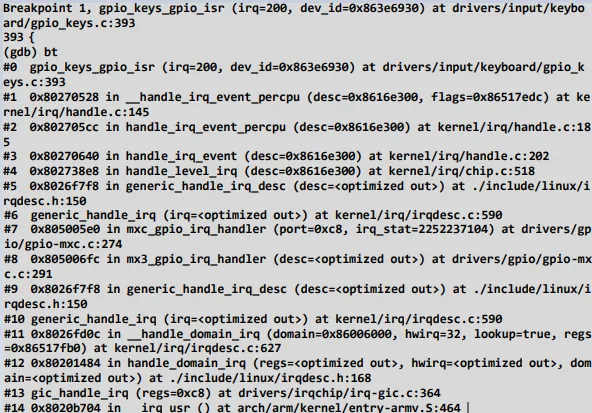 从打印可以看出注册的上半部硬件中断
handler的调用流程。
4.2.2 thread_fn的调用过程
来看gpio_keys_gpio_isr是如何一层层调用上来的。从__handle_irq_event_percpu开始分析:(它在kernel\irq\handle.c中)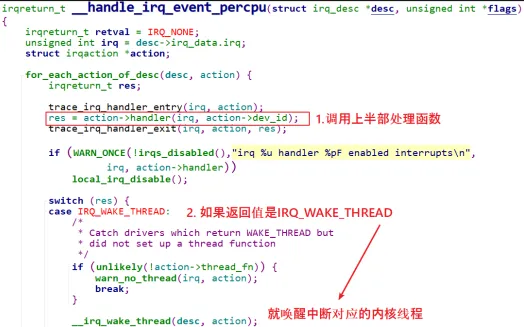 执行上半部提供的的
handler函数。判断上半部返回值如果是IRQ_WAKE_THREAD,就调用__irq_wake_thread唤醒中断线程处理函数。
如果上半部返回值是IRQ_HANDLED,表示该中断无需线程化处理,直接退出。
4.2.2.1 __irq_wake_thread分析
它在kernel\irq\handle.c中:
void __irq_wake_thread(struct irq_desc *desc, struct irqaction *action){
	......
	atomic_inc(&desc->threads_active);
	wake_up_process(action->thread);
}唤醒的是谁,就是action->thread,也就是对应前面kthread_create出来的irq_thread,再次贴图如下:
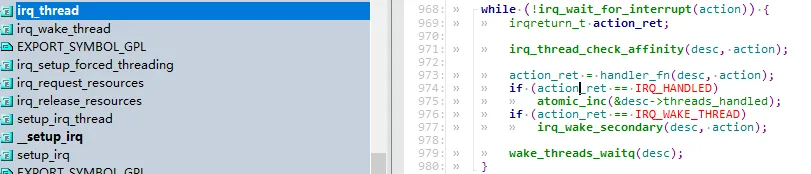
4.2.2.2 irq_thread函数分析
在kernel\irq\manage.c,平时irq_thread是处于休眠idle状态,不占用cpu资源。
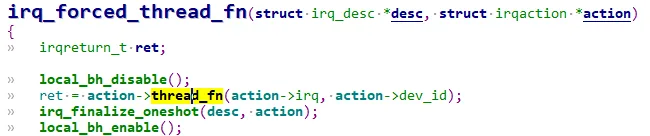
当被唤醒后,irq_thread进入唤醒状态调用handler_fn,也就是最终使用者预先设定的action->thread_fn。
/*
 * Interrupt handler thread
 */
static int irq_thread(void *data){
	struct callback_head on_exit_work;
	struct irqaction *action = data;
	struct irq_desc *desc = irq_to_desc(action->irq);
	irqreturn_t (*handler_fn)(struct irq_desc *desc,
			struct irqaction *action);

	if (force_irqthreads && test_bit(IRQTF_FORCED_THREAD,
					&action->thread_flags))
		handler_fn = irq_forced_thread_fn;
	else
		handler_fn = irq_thread_fn;

	init_task_work(&on_exit_work, irq_thread_dtor);
	task_work_add(current, &on_exit_work, false);
	irq_thread_check_affinity(desc, action);
	while (!irq_wait_for_interrupt(action)) {
		irqreturn_t action_ret;
		irq_thread_check_affinity(desc, action);
		action_ret = handler_fn(desc, action);//调用irq_thread_fn
		if (action_ret == IRQ_HANDLED)
			atomic_inc(&desc->threads_handled);
		if (action_ret == IRQ_WAKE_THREAD)
			irq_wake_secondary(desc, action);
		wake_threads_waitq(desc);
	}
/*
 * Interrupts explicitly requested as threaded interrupts want to be
 * preemtible - many of them need to sleep and wait for slow busses to
 * complete.
 */
static irqreturn_t irq_thread_fn(struct irq_desc *desc,
		struct irqaction *action){
	irqreturn_t ret;
	ret = action->thread_fn(action->irq, action->dev_id);//调用使用者预先设定的action->thread_fn
	irq_finalize_oneshot(desc, action);
	return ret;
}